
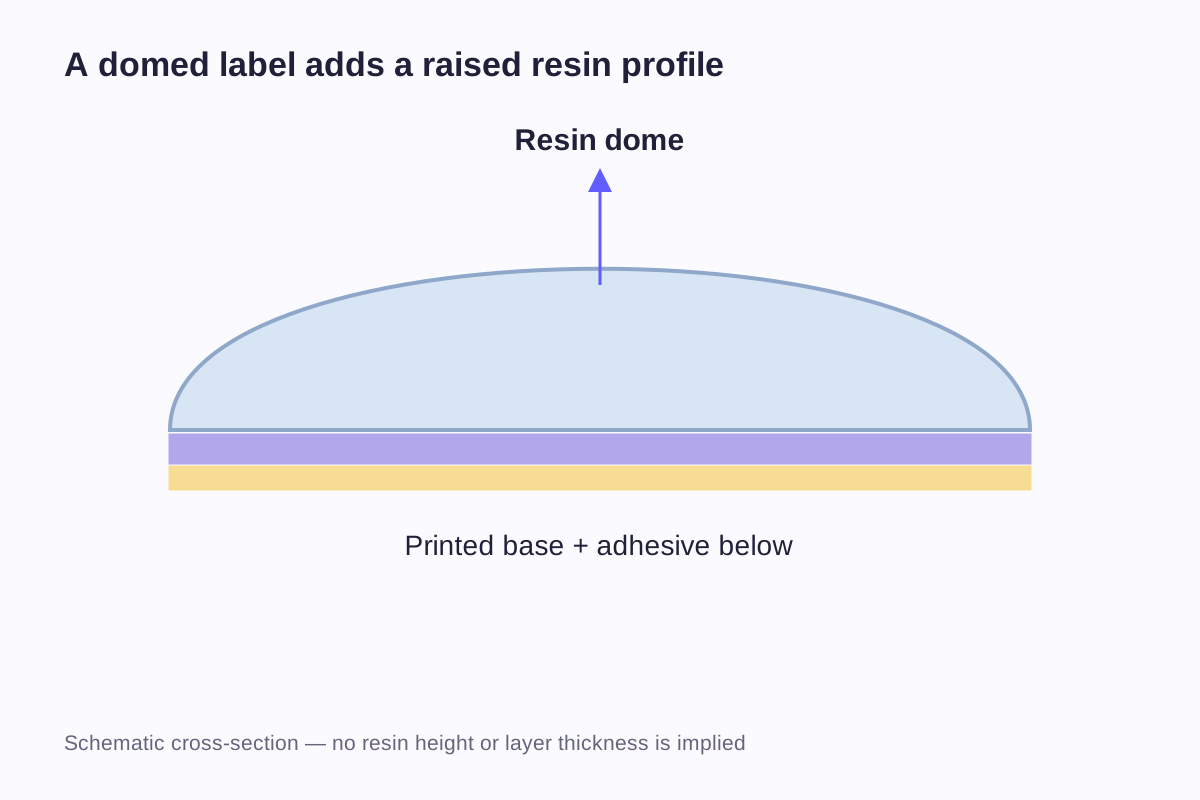
A domed sticker has a raised clear coating over its printed image. From above, the artwork may resemble a conventional label. From the side, the added resin changes the profile and the amount of space the badge occupies. That third dimension matters when the sticker fits into a recess, sits beside a moving part or is intended to feel raised under a fingertip.
“Epoxy” and “domed” are often used together, but they describe different things. Epoxy names a resin chemistry. Domed describes the finished shape. A useful specification identifies both, then gives the label's outline and the thickness measurements that matter to its installation.
How a clear dome changes the sticker
A simplified domed label consists of printed artwork on a base, a raised clear resin layer and adhesive underneath. A release liner protects the adhesive before application and is removed when the label is installed. The exact construction can vary, so the word “thickness” needs a stated reference point.
A glossy protective film and a resin dome can both produce shine, but they do not describe the same profile. A thin film follows the underlying label surface. A dome gives the face a distinct raised contour. A photograph taken from directly above may show both as glossy, which is why a side view is valuable.
For a logo badge, the dome also changes where reflections appear relative to the printed image. The artwork sits beneath the clear surface rather than being the outermost face. An enlarged digital mock-up cannot establish how small lettering will look through the finished resin profile, especially close to the curved edge.
The sticker materials guide explains why a face-material measurement is different from a complete label measurement. The same distinction becomes more important once a raised coating is added.
Epoxy is one resin option within the wider doming category
Resin manufacturers supply more than one chemistry for doming. Fong Yong's doming-resin information lists epoxy, polyurethane and UV-curing systems, along with different hard and flexible formulations. The resin type therefore belongs alongside “domed” in the product description.
| Description | What the name identifies | What it does not establish by itself |
|---|---|---|
| Epoxy dome | An epoxy resin system | A particular hardness, height or outdoor service life |
| Polyurethane dome | A polyurethane resin system | That it matches another PU grade's flexibility or exposure performance |
| UV-cured doming resin | A resin system cured using UV light | The finished coating's thickness or suitability for a particular mounting surface |
| Domed sticker or label | A raised, clear-coated product form | Which of those resin systems was used |
WiseSticker's custom epoxy sticker collection concerns epoxy products. The broader resin comparison here explains industry terminology; it is not a list of polyurethane or UV-cured resin options offered by WiseSticker.
Resin formulations can differ in hardness and response to exposure even when their glossy surfaces look similar. Compare the proposed cured resin's data with the way the badge will be fitted, handled and exposed, then inspect a finished sample on the product. Its feel, fit and attachment depend on more than the resin's family name.
Give the footprint and raised profile separate dimensions
The footprint is the label's outline as seen from above. A circular badge can be described by diameter; a rectangle or irregular shape needs its maximum width and height. Those numbers describe the space it occupies on the panel, not how far it projects from it.
The raised profile needs a side view. A dome may be higher near its center than at its edge, so the location of a measurement matters. “Overall thickness at the highest point, excluding the release liner” is much clearer than “thick epoxy sticker.”
| Dimension | Reference used | Why it matters |
|---|---|---|
| Finished width and height | Maximum outside dimensions of the label | Determines whether the footprint fits |
| Resin height | Resin base to its highest point | Describes the raised layer itself |
| Installed overall thickness | Mounting-side adhesive surface to highest finished point | Describes the total projection from a flat mounting surface |
| Thickness with liner | Includes the removable backing | Useful for supplied material, but not the installed profile |
| Recess depth | Mounting floor to surrounding panel face | Determines whether the badge sits below, near or above that face |
A 1 or 2 mm resin layer shown in another listing does not establish the height of your badge. State the projection your product needs and have the proposed resin and outline assessed against it. Keep resin height separate from the overall installed thickness.
The measurement method also belongs with a tight thickness requirement. Pressure from a measuring tool and the point of contact can affect a reading on a shaped or compliant surface. A result recorded at the center cannot simply be compared with one taken near an edge as though they measured the same feature.
Four outlines reveal different design problems
The following dimensions are illustrative drawing sizes. They are useful for comparing layout and mounting questions, not as a standard product range.
| Example footprint | Likely layout question | Mounting question worth resolving |
|---|---|---|
| 20 × 20 mm | Can the symbol work without a small secondary line? | Is there enough surrounding space to position the badge? |
| 30 × 30 mm | How much room does a border leave around the image? | Does the outline fit the available flat area? |
| 50 × 20 mm | Can a long wordmark remain clear inside the raised edge? | Does a narrow recess match the corner shape? |
| 60 × 40 mm | How are the emblem and supporting text balanced? | Does the full area sit against the surface, or cross a curve? |
A rectangle with rounded corners needs more than a width and height if it sits in a shaped recess. The corner radius changes the fit. A 50 × 20 mm badge and a nominally 50 × 20 mm recess can still conflict if their corners differ.
An irregular logo adds further questions. A long, thin projection is different from a compact oval; a narrow connection between two larger areas is different from one continuous rounded panel. The outline should show those features rather than hiding them inside a rectangular bounding box.
The sticker size guide covers measuring that outside box. For a resin-coated design, include the detailed contour alongside those overall dimensions. Show narrow connections, projecting ends and corner radii so the outline can be assessed without guessing what lies inside the bounding box.
Worked example: a 50 × 20 mm badge in a recess
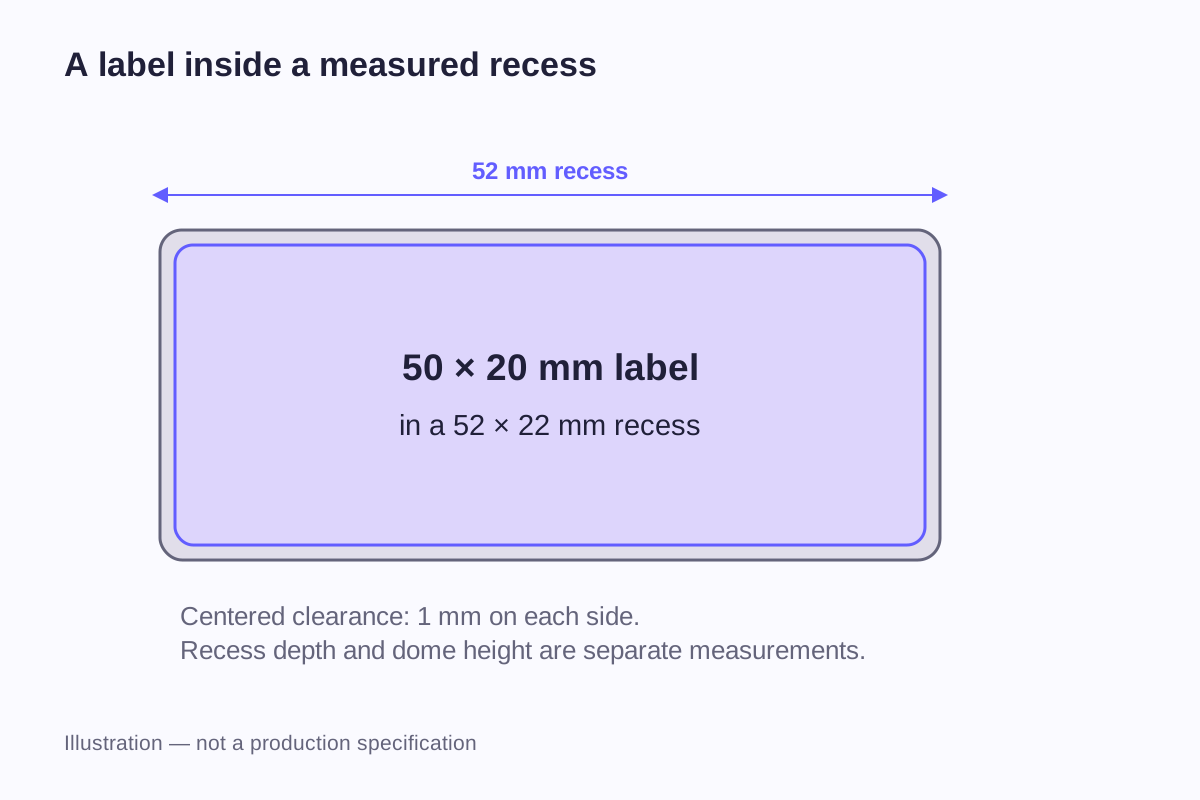
Suppose a product panel has a flat rectangular recess measuring 52 × 22 mm. A proposed badge measures 50 × 20 mm. If centered, the nominal horizontal clearance is:
(52 − 50) ÷ 2 = 1 mm on each side
The nominal vertical clearance is also:
(22 − 20) ÷ 2 = 1 mm above and below
That result only describes the top view. It does not establish whether the badge sits flush, whether the corner shapes match or whether the panel and badge tolerances leave sufficient clearance.
A side view adds two dimensions: recess depth and installed maximum badge thickness. For an illustrative fit calculation, assume the recess is 1.5 mm deep and a proposed finished construction is 1.8 mm thick at its highest point. The nominal projection above the surrounding panel is 1.8 − 1.5 = 0.3 mm. These are hypothetical design inputs, not measured WiseSticker product specifications.
That 0.3 mm can be welcome when a tactile emblem is desired. It can be a problem if a cover slides across the panel. The correct decision depends on the neighboring parts, not on whether a thicker dome looks more impressive in isolation.
The recess floor also matters. Its nominal dimensions do not prove that it is flat, clean or compatible with the adhesive. A photo looking directly at the panel may hide a curve or a surface texture. A drawing and a representative physical part answer different parts of the fit question.
Hardness describes something different from gloss
A clear glossy appearance does not tell you whether the resin is soft or hard. Supplier data can help distinguish formulations, provided the grade and scale stay attached to the number.
Taiwan PU lists the following values for three polyurethane doming grades. Its page describes the figures as approximate reference data rather than a product specification. The grades are presented here to explain the information a resin supplier may publish, not as WiseSticker materials. Taiwan PU doming-resin data.
| Supplier grade | Published hardness |
|---|---|
| CPU-105-268B-A/B | 69 Shore A |
| CPU-105-278B-A/B | 80 Shore A |
| CPU-105-293B-A/B | 90 Shore A |
These figures all use Shore A; the same numbers on Shore D would not mean the same hardness. A hardness figure also does not, by itself, describe how an entire finished label bends. Thickness, outline and the other layers affect that behavior too.
For a badge on a flat, rigid panel, compare how the raised face feels when pressed as well as its hardness data. On a curved object, also assess whether the complete label follows the surface and remains attached. These are separate checks even when two resin grades look equally glossy.
A flexible label still needs a suitable mounting surface
A badge that bends in the hand has not necessarily demonstrated that it will remain attached to a particular curve. The assembled label, adhesive and mounting surface have to work together after the part is released and used.
There are two different geometric questions. One is whether the label can follow the local curvature. The other is whether its whole outline has a usable surface underneath it. A flexible badge spanning a seam, ridge or recessed screw position can still lack continuous support.
Surface finish also belongs in the description. Bare metal, painted metal and powder-coated metal are different contact surfaces even if the underlying component is the same. A photo of a generic flat plate is less informative than a representative finished part when the adhesive will actually contact the coating.
For a curved logo area, the label's orientation can matter. The long side of a 50 × 20 mm badge spans more of the curve when placed around a cylinder than when aligned along its length. Show the cylinder's diameter and the badge's orientation in a top-and-side sketch so the fit can be assessed for that specific label and mounting surface.
Separate appearance observations from exposure claims
A useful first sample can answer several immediate questions: whether the wordmark fits, whether the edge profile looks appropriate, whether the badge sits within the recess and whether neighboring parts still move freely. Those are different questions from long-term yellowing, abrasion or outdoor exposure.
The latter need evidence for the particular resin and finished construction under relevant conditions. A clear appearance when new is not an outdoor-life rating. Likewise, a glossy resin face does not establish how the adhesive will behave during washing.
For a product exposed to water, the waterproof and water-resistant sticker guide separates splashes, condensation, immersion and cleaning. Describing the actual exposure is more useful than adding “waterproof” to an otherwise incomplete domed-label specification.
On the product drawing, show the top-view outline, installed profile, artwork position and mounting area. Note nearby moving parts and the handling, cleaning or outdoor conditions the badge will face. Fit the sample to the product to inspect clearance and appearance, with any exposure testing agreed separately.
Frequently asked questions
No. Domed describes the raised coated form, while epoxy identifies one resin chemistry. Other resin systems exist in the wider industry. A specification should name the intended resin or identify the actual supplier material rather than assume that every product described as a dome has the same construction.
No. Resin height refers to the raised layer, while finished thickness can include the printed base and adhesive. Some supplied-material measurements also include a release liner. For a recessed badge, the most useful installed measurement runs from the mounting surface to the highest point, with the liner excluded.
Flexibility alone does not establish that. The size and orientation of the badge, the curve, the adhesive and the surface finish all affect the application. A representative part is more useful than a general statement that the object is curved, especially when a long badge wraps around a narrow cylinder.
More height changes the profile, but it is not automatically a better design. It can affect how the image looks near the edges and how far the badge projects from its mounting area. The desired appearance should be considered together with clearance, handling and the amount of small text beneath the resin.
Use information for the specified resin and finished construction, with the exposure conditions and test method identified. A generic claim about epoxy or polyurethane does not establish a service life for your label. The intended light, heat, moisture and cleaning exposure need to match the evidence being used.
Related guides
- Sticker Materials Explained: Vinyl, PET and Paper
- Sticker Size Guide: Dimensions in Inches and Millimeters
- Waterproof vs Water-Resistant Stickers: What to Look For
Send the logo, finished outline and a photo or drawing of the mounting area. Include the depth of any recess so the raised profile can be considered alongside the width and height.
Discuss Epoxy Stickers