
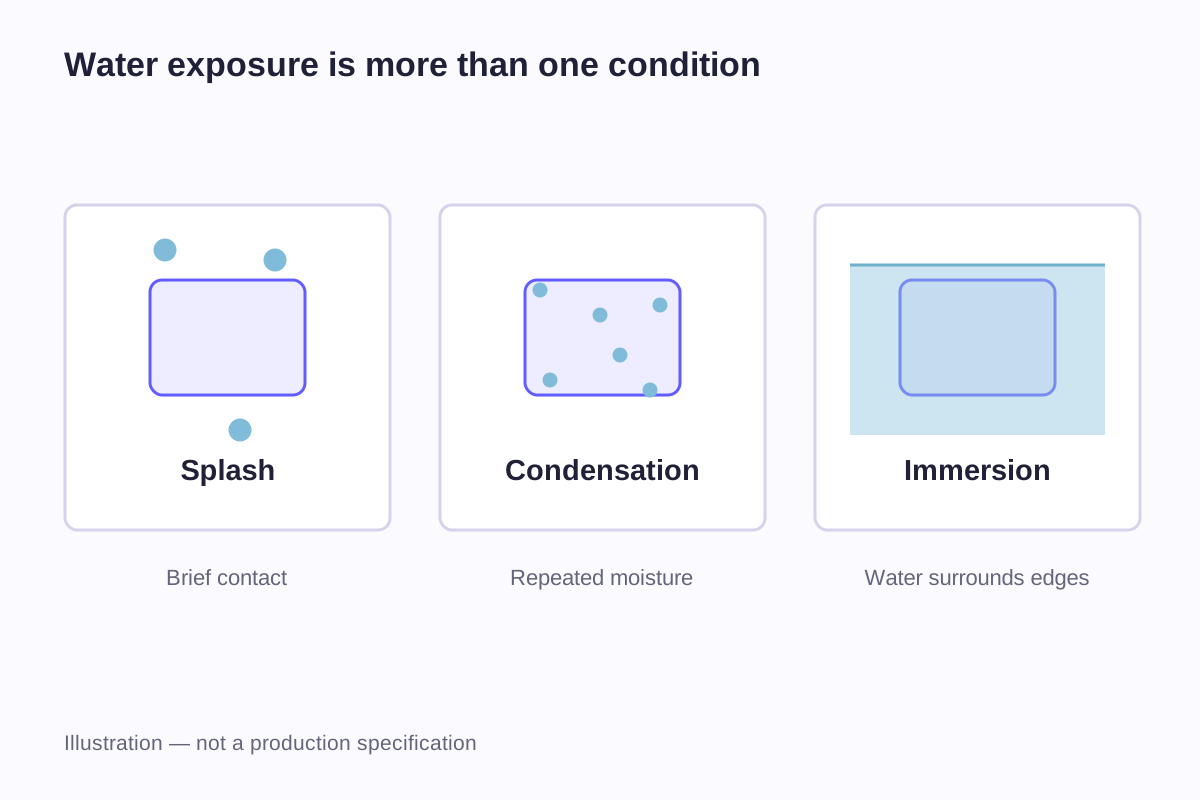
A label can retain its printed colors while lifting at the corners. It can also remain firmly attached while the wording smears. That is why a water-resistance description needs to cover both the printed image and the way the label stays attached.
An occasional splash, condensation on a chilled bottle, time in an ice bucket and repeated washing expose a label to different conditions. The face material, print and adhesive need to suit the kind of water contact your product encounters. A film that survives a splash is only part of that decision.
What waterproof and water-resistant usually mean
In its waterproof and water-resistant label explanation, Avery distinguishes resistance to splashes, light moisture and condensation from labels designed for more prolonged water exposure, including submersion. For a buyer, the next step is to compare the product's stated water-contact conditions with how the label will be used.
The word “waterproof” leaves out the water temperature, duration, surface being labeled and whether the print was rubbed while wet. Detergent, sunlight and high-temperature washing add conditions that need their own supporting product information.
For a purchase decision, replace “Will it get wet?” with “How will water reach it, how often, and what else happens at the same time?” That gives a material recommendation something specific to address.
Compare the exposure before comparing materials
| Exposure | What happens to the label | Information to record | Separate issue that may also matter |
|---|---|---|---|
| Occasional splash | Water contacts part of the face, then drains or is wiped away | Water type, approximate contact time and wiping | Rubbing of wet print |
| Condensation | Moisture forms on a chilled container | Container temperature conditions, time out of refrigeration and whether it was labeled dry | Adhesion during application |
| Ice bucket or soaking | The face and edges remain in contact with water | Water temperature, immersion depth and duration | Edge lifting or changes in the face material |
| Hand washing | Water contact combines with wiping and possibly detergent | Actual cleaning method, cleaner and repeated exposure | Abrasion and chemical compatibility |
| Dishwasher use | Water combines with heat, detergent and the machine's cycle | Program, placement and the intended number of cycles | A distinct appliance-use assessment |
| Outdoor exposure | Rain is one part of a changing environment | Placement, exposure, temperature conditions and intended service period | Sunlight and weathering |
A brief splash tells you little about how the same label behaves during soaking or washing. Each row describes a different use condition, not a rating for a particular product. The relevant comparison is with the conditions your label will actually encounter.
Some products go through several of these conditions. A chilled drink may first develop condensation, then sit in ice and finally be handled with wet hands. Trying a sample through that sequence shows more about its intended use than observing each stage in isolation.
Four parts of the sticker can respond differently
The face, print, optional laminate and adhesive can change independently when a label gets wet. Looking at each part helps locate a problem before changing materials. The sticker materials guide explains how those layers fit together.
| Part to observe | Visible change worth recording | What that observation means |
|---|---|---|
| Face material | Swelling, wrinkling, discoloration, tearing or loss of shape | The face has changed under the recorded conditions |
| Printed image | Smearing, transfer, fading or loss of small detail | The printed information or decoration has changed |
| Laminate or finish | Cloudiness, separation, bubbles or changes at the edge | The surface layer or its bond needs investigation |
| Adhesive contact | Lifted corners, spreading edge separation or movement on the item | The label is no longer maintaining the intended contact in those areas |
A lifted corner does not, on its own, identify the cause. The surface, application, shape or material combination could all be involved. Replacing the face film while keeping everything else the same may leave the edge-lifting problem unresolved.
An intact face is only one part of the result
A film may remain visibly whole while the bond to the container changes. If the label carries instructions, the text also needs to remain readable. For a decorative sticker, a cloudy surface or a discolored edge may be unacceptable even if the sticker does not detach.
Decide what the job requires before comparing samples. “Still attached,” “all text readable” and “no visible appearance change” describe different results. A label can meet one of them and fail another, so record each separately when all matter to the product.
Lamination is not a complete water rating
Lamination covers the printed face. Water can still reach cut edges, and the adhesive still has to hold the label to the container. A laminate's water properties therefore cannot tell you, by themselves, whether the whole label will stay attached.
When a supplier recommends a laminated label for wet use, the recommendation should cover the base stock, print, laminate and adhesive together. Data for an unprinted film leaves the other layers unaddressed, even if the film itself shows no visible change in water.
Match the adhesive to the container's surface
Two plastic bottles can use different resins or surface treatments, so their adhesive requirements may differ. Coated glass also presents a different contact surface from bare glass. Identifying that outer surface is more precise than describing both items simply as plastic or glass bottles.
The adhesive touches the outermost surface. Paint, varnish or another coating therefore belongs in the description. Oil, moisture and other material on that surface can also change the installation conditions.
Record the condition when the sticker is applied, then the conditions it encounters afterward. Applying a label to a dry bottle and later refrigerating it is not the same sequence as trying to apply it to a bottle already covered in condensation.
Preparation, application conditions and any waiting period before water exposure should follow the selected material's instructions. The waiting time varies with the adhesive. In a side-by-side comparison, record the delay for each sample so a difference in bonding time is not mistaken for a difference in materials.
Four everyday applications, four different briefs
Refrigerated drink bottles
The brief should identify the container material, whether labeling happens before chilling and what occurs when the drink leaves the refrigerator. If bottles also sit in ice, include that exposure rather than describing the whole application as condensation.
A wet-use roll label also needs to fit the packing operation. Its printed material has to suit the bottle, while its dimensions and roll arrangement have to suit the way labels are fed and applied. The roll label specification guide covers those supply details.
Bathroom packaging
A bottle used beside a sink may encounter occasional water and wiping; one kept in a shower may have much more frequent contact. The product contents can matter too if they spill over the label.
Describe the actual routine and any cleaning products involved. Water resistance does not automatically establish resistance to soap, oil or another product. If the container is squeezed during use, include that handling when discussing the sample.
A reusable bottle washed by hand
The label may face warm water, detergent, a cloth or sponge, and repeated handling at its edge. A simple observation with still water does not reproduce that combination.
Gentle rinsing and scrubbing put different demands on the print and edges. Using the intended washing method consistently makes samples easier to compare, so record that method with the results. A specific washing claim needs a test that matches the claimed use, including the cleaner and handling involved.
An outdoor sign or vehicle graphic
Rain exposure is only one part of outdoor use. Sunlight, changes in temperature, dirt and cleaning can affect different parts of the graphic over time.
The material request should therefore include the location and intended service conditions. The car and window decal guide also distinguishes installation side and viewing side, which can change where a graphic is placed and what it encounters.
A practical way to compare printed samples
Trying printed samples on the intended container can reveal problems with application or everyday handling. It can help narrow the material choice, while a formal performance claim still needs the specified testing and documentation behind it.
Avery describes its own label durability testing. When reading a test report, look for the label material, print, surface and method used. Avery's results apply to its tested products; they do not provide a rating or certification for a WiseSticker label.
Keep the comparison controlled
For an initial comparison, an illustrative 50 × 30 mm rectangle gives every candidate the same shape and printed area. Each rectangle has an area of 1,500 square millimeters and a perimeter of 160 mm. These are geometric values, not recommended test dimensions or production limits.
Using the same outline prevents a large change in size or shape from being mistaken for a material difference. A round corner, narrow extension or different edge length could otherwise introduce another variable. After the initial comparison, the actual production shape still needs assessment on its intended item.
Keep the artwork constant too, including the same small wording, solid color and unprinted areas where they matter to the design. Compare finished printed labels with their proposed finishes. Comparing bare film with a printed laminated label changes several things at once and makes the cause of a difference harder to identify.
| Variable | Keep consistent for a direct comparison | Record separately when it changes |
|---|---|---|
| Sample | Shape, dimensions and printed artwork | Material reference, adhesive and finishing |
| Receiving item | Material, finish and preparation | Container version or coating |
| Application | Method and conditions | Application date and any variation |
| Exposure | Water source, temperature, contact and handling method | Actual duration and repeated exposures |
| Inspection | Viewing conditions and observations sought | Changes while wet and after drying |
For a comparison of paper, film and laminated film, record the material reference, adhesive and finish for each sample. A label such as “film B” only helps if it can be traced back to those details. The observations can then guide a repeat sample or a material change.
Record the starting condition
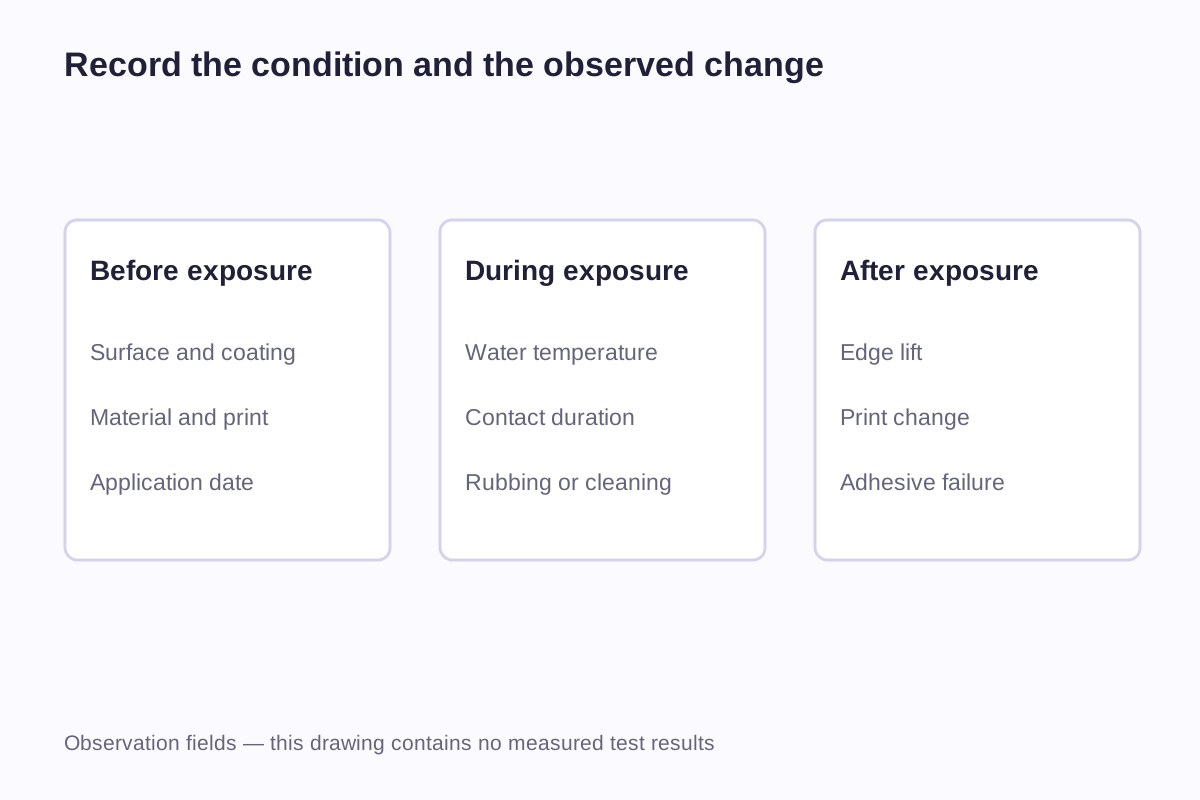
Give each sample a clear identifier and photograph it before exposure. Note any bubbles, wrinkles or lifted areas already present. Otherwise, a defect introduced during application may later be mistaken for a change caused by water.
Record when the sticker was applied, the surface preparation used and the elapsed time before exposure. If the selected material has application instructions, retain those with the record so the conditions can be compared with the intended method.
Use the exposure that matters to the product
The log needs the actual temperatures and durations from the observation, alongside the chosen product-use method or test procedure. Recording them as the work is done avoids having to reconstruct the conditions afterward.
For a comparison involving washing, identify the cleaner and handling method. For condensation, identify the sequence of chilling and exposure to the surrounding air. For immersion, state whether the whole label, including its edges, was under water.
Where several units are observed, keep a record for each. This shows whether a lifted edge appeared on one sample or across several, and whether the samples behaved differently while wet or after drying. A single group description can lose those differences.
Inspect more than the printed colors
Look at the center, corners and complete perimeter. Note whether a change appears while wet, after drying or only during handling. Keep print observations separate from adhesion observations.
Photographs are easier to compare when their angle, lighting and distance are consistent. Describe the location of a change in words too: an edge, a corner, a printed block or the boundary between layers. “Looks worse” is harder to investigate than a specific observation.
The sticker water-exposure log provides fields for sample identification, surface, application, exposure and observed changes. Use it to keep each sample's conditions and results together, including any differences between observations while wet and after drying.
Use the results to narrow the material choice
A sample report should connect each result to a named printed label, container, application method and exposure procedure. That makes it possible to compare a repeat sample or investigate a lifted edge without reconstructing the setup from memory.
A hand-washing result applies to that method. Dishwasher cycles, multi-year outdoor use and a different coated container need their own supporting data. A short indoor water comparison cannot establish those outcomes, even when the labels or containers have the same broad material names.
If the result is unsatisfactory, change one relevant variable at a time where practical. Altering the face, adhesive, laminate and container together may produce a different result, but it will not reveal which change addressed the original issue.
For a custom sticker order, include the planned water contact and any required test results when discussing materials and printing. Sample development lets you review the proposed print and discuss how to try the sample on the intended container before bulk production. Additional testing needs an agreed method and scope.
Frequently asked questions
No. Vinyl identifies the face material. Water performance also depends on the ink, finish, adhesive, surface being labeled and type of water contact. The relevant product information should cover the finished label with those components and conditions, rather than the film alone.
Lamination adds a layer over the printed face, but that does not establish the behavior of the adhesive or the cut edges. The whole construction needs to be suitable for the intended exposure. A laminate's own properties should not be treated as a complete finished-label rating.
Only when that use is supported for the specific product and conditions. A dishwasher introduces heat, detergent, water action and repeated cycles. A general waterproof description does not establish resistance to that combination, and hand-washing observations do not demonstrate the same result.
Record it as an adhesion or edge-contact problem even if the print remains readable. The label's intended function may require both appearance and attachment. The receiving surface, application, shape and adhesive construction should be considered when investigating the cause.
No. Condensation forms moisture on the container, while immersion exposes the label and its edges to sustained contact. The application sequence also matters: a label applied dry and later chilled has a different starting condition from one applied to a wet container. Describe the actual use rather than treating these exposures as interchangeable.
Related guides
- Sticker Materials Explained: Vinyl, PET and Paper
- Roll Label Specifications: Size, Core, Diameter and Unwind Direction
- Car and Window Decal Size Guide: Placement and Viewing Side
Tell us the container surface and whether the label will face splashes, condensation, soaking or washing. Include the cleaning and storage conditions, design size and quantity so we can discuss materials and a sample.
Discuss the Application