
A label can be vinyl, clear and glossy at the same time: those words describe its film, transparency and surface finish. A waterproof claim adds a different question: how does the finished label perform when it gets wet? Separating these details makes material quotations easier to compare.
Two stickers made from the same face material can behave differently because their adhesives, printing or finishes differ. Two different materials can also look alike in a photograph. To compare them properly, you need to know what sits above and below the face material as well as its name.
What is included in a sticker?
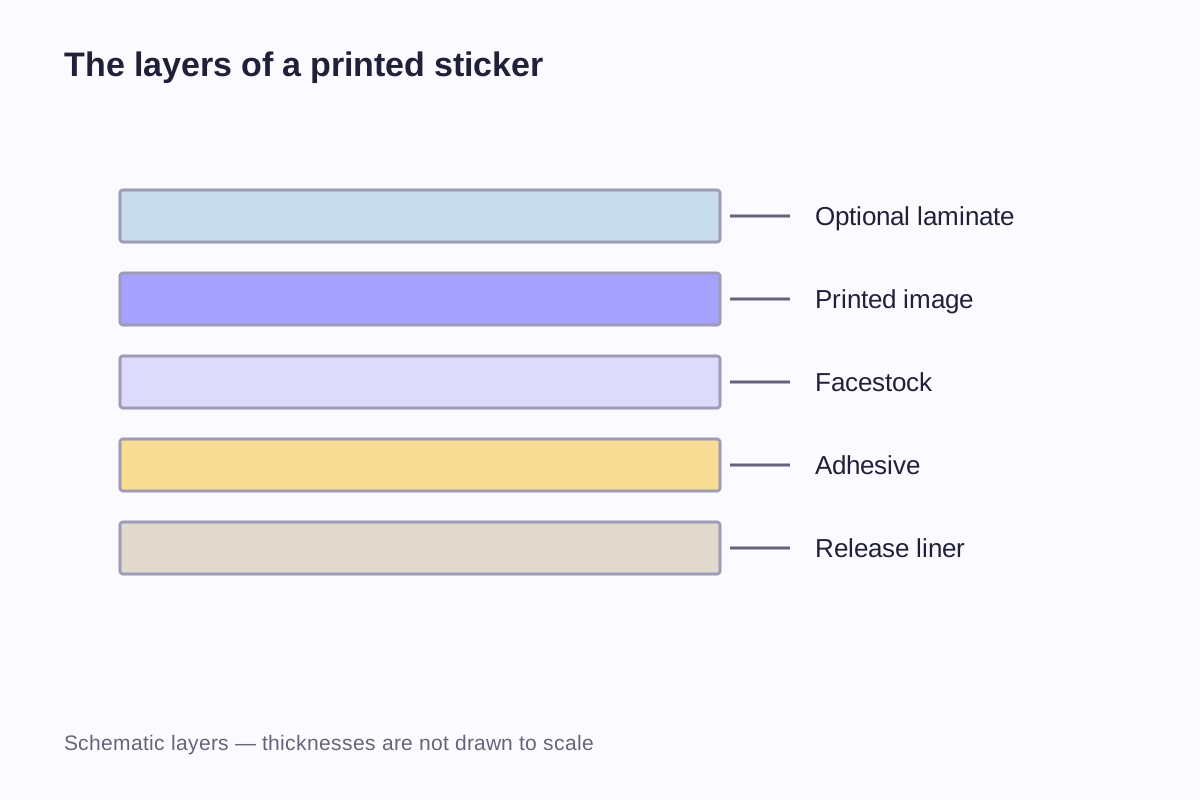
A pressure-sensitive printed sticker usually consists of a face material, printed artwork and adhesive, supplied on a release liner. Depending on the design, there may also be a topcoat, laminate or special finish. These layers perform different jobs.
| Part of the construction | What it does | Present after application? | Useful question for the quotation |
|---|---|---|---|
| Face material | Carries the printed design and forms the sticker body | Yes | What material and grade are proposed? |
| Printed ink | Creates the wording, colors and graphics | Yes | Which printing method suits this artwork and stock? |
| Optional laminate or finish | Adds a surface layer or a selected visual effect | Yes, if specified | Is it included, and which areas does it cover? |
| Adhesive | Bonds the sticker to the receiving surface | Yes | Has this combination been assessed for that surface and use? |
| Release liner or backing | Supports the sticker before application | No | Does the quoted thickness include it? |
The liner is removed before the sticker is applied. A thick backing can make a loose sample feel substantial in the hand, but that backing is not part of the sticker left on a bottle or package.
A laminate stays over the print after application; the liner peels away from the adhesive. Calling both a “protective film” can make an order unclear. Naming the layer tells the supplier whether you mean a permanent surface finish or the removable backing.
For a layered decorative product, the distinction becomes more important. A resin dome adds height above the printed face and is measured differently from a flat film. The epoxy and domed sticker guide explains the difference between base thickness, resin height and the complete profile.
Vinyl and PVC are often overlapping names
In sticker and graphics catalogs, vinyl commonly refers to PVC film. A quote may use either name for the same type of film, so seeing both names does not necessarily mean you are comparing different polymers.
ORAFOL's ORACAL 640 Print Vinyl, for example, is named “Print Vinyl” and described as soft PVC film. Both terms refer to the same product. Its particular grade and adhesive still distinguish it from other materials sold as vinyl.
A quotation for vinyl should name the film grade and adhesive. Their specifications let you compare thickness, flexibility, transparency, removal behavior and expected service life. A broad description such as “vinyl sticker” leaves those differences hidden.
If vinyl and PVC appear as separate priced options, compare the material references, adhesives and finishes. A difference in grade or finishing can explain a price difference; the names vinyl and PVC alone cannot. Keeping those details with the quote also makes a later reorder easier to specify.
How paper, PVC/vinyl and PET differ as starting materials
Paper and film are different material families. PET is polyethylene terephthalate, a polyester film; PVC is polyvinyl chloride. Within each family, grades, coatings and adhesive combinations affect the finished label.
| Starting material | What the name establishes | Appearance choices to discuss | What the name does not establish |
|---|---|---|---|
| Paper | A paper face rather than a plastic film face | Surface texture, whiteness, printed finish and any coating | Moisture performance, adhesive suitability or one fixed thickness |
| PVC/vinyl | A PVC film when that composition is specified | Clear or colored face, print and surface finish | A universal outdoor life, removal behavior or film grade |
| PET | A polyester film face | Clear, white or other specified appearances | Suitability for every surface, chemical or temperature |
| Special-effect construction | An additional material or finish creates the effect | Metallic reflection, holographic appearance or resin profile | The underlying polymer, adhesive or complete performance |
Paper labels
A paper label can form a distinct panel on a box, bag or product. Its base color and texture become part of the design, especially where the print leaves the paper exposed. Those features are worth comparing alongside the printed artwork.
A smooth coated paper, a textured stock and a laminated paper label can look and feel different. A coating intended to improve printing also serves a different purpose from a water-protection claim. Suitability for submersion has to apply to the finished label, including its print and adhesive.
For an indoor package, useful sample comparisons include the paper's color, how small text prints, whether the surface is intended to be written on and how the label looks against the package. Any moisture, rubbing or removal requirement belongs in the application brief rather than being inferred from the word paper.
PVC/vinyl film
PVC/vinyl graphics range from small logos and shaped illustrations to larger panel graphics. The right film depends on where the graphic will be applied and how the item will be used, rather than on the artwork being called a logo or a label.
A film selected for a flat promotional item should not automatically be carried over to a coated vehicle panel. The receiving surface, curvature, handling, exposure and intended removal all matter. Those details are more useful for selection than a general request for “strong vinyl.”
The quotation should identify the proposed construction closely enough that a repeat order can refer to it. A vague material name can conceal a change in grade or adhesive even when the printed design remains unchanged.
PET film
PET is used for labels including technical identification. HERMA's PET material overview describes industrial uses and identifies approvals for specified PET materials paired with its 63B adhesive. The material and adhesive listed in an approval need to match the proposed label; an approval for that pair does not cover every PET sticker.
A PET label for equipment might need to withstand a cleaner, stay attached to a coating or remain legible during handling. The relevant data should cover the proposed PET grade, adhesive and printed finish on that surface. A result from a different installation may leave those requirements unanswered.
Clear, white and reflective describe another choice
The face material and its appearance should be stated separately. “Clear sticker” describes transparency; it does not identify whether the proposed film is PET or PVC. “White sticker” describes the background visible behind the print, not the adhesive.
On clear PET or PVC stickers, unprinted areas reveal the item behind the label. A design shown against a white screen can look different on a dark container or in front of colored contents. That change is part of the visual result and should be considered before the print is approved.
The clear versus white sticker guide separates transparent film, a white face and a white ink layer. White ink is an additional printing requirement: ordering clear film alone does not request it. Any intended white areas need to be discussed with the proposed printing method.
A metallic or holographic appearance adds a further variable. It may draw attention to the area around the printed logo, while dense printed elements can leave less of the effect visible. When comparing samples, use the same design and outline so the material remains the main changing factor.
Matte and gloss: compare the surface, then assess performance
Matte and gloss describe how the surface appears under light. They do not, by themselves, identify the material beneath it or prove resistance to scratches, water or cleaning products.
A glossy surface produces more distinct reflections. A matte surface spreads reflected light more broadly, so the visible glare is different. The effect on a design depends on the viewing angle, lighting and printed colors. Neither finish is always easier to read in every setting.
Use one 50 × 50 mm design for an appearance comparison, with identical wording, colors and outline. This is a comparison size, not a manufacturing minimum. View the samples together, then change their angle rather than photographing one under favorable light and the other under glare.
| Observation | What to compare | What it cannot establish alone |
|---|---|---|
| Straight-on view | Color, small text and the visible background | Scratch resistance |
| Light at an angle | Reflections across the logo and wording | Outdoor durability |
| On the intended item | Background contrast and overall appearance | Long-term adhesion |
| Handled sample | Surface feel and any visible marks from that handling | A formal abrasion rating |
Record which construction produced the appearance: the stock itself, an added laminate or another finish. “Glossy” on one quotation may not describe the same layer as “glossy” on another.
Reading thickness: microns, millimeters and mils
A micron, written µm, is one thousandth of a millimeter. A mil is one thousandth of an inch; it is not a millimeter.
| Measurement | Equivalent value | Note |
|---|---|---|
| 1 µm | 0.001 mm | Metric thickness unit |
| 100 µm | 0.100 mm | Exact conversion |
| 1 mil | 0.0254 mm | Exactly 25.4 µm |
| 100 µm | Approximately 3.94 mil | Rounded from the exact conversion |
| 4 mil | 0.1016 mm | Slightly thicker than 0.100 mm |
Every thickness number needs a description of the layers included. “100 µm face film” and “100 µm face plus adhesive” are different constructions. A figure measured with the liner still attached describes something else again.
A real datasheet calculation
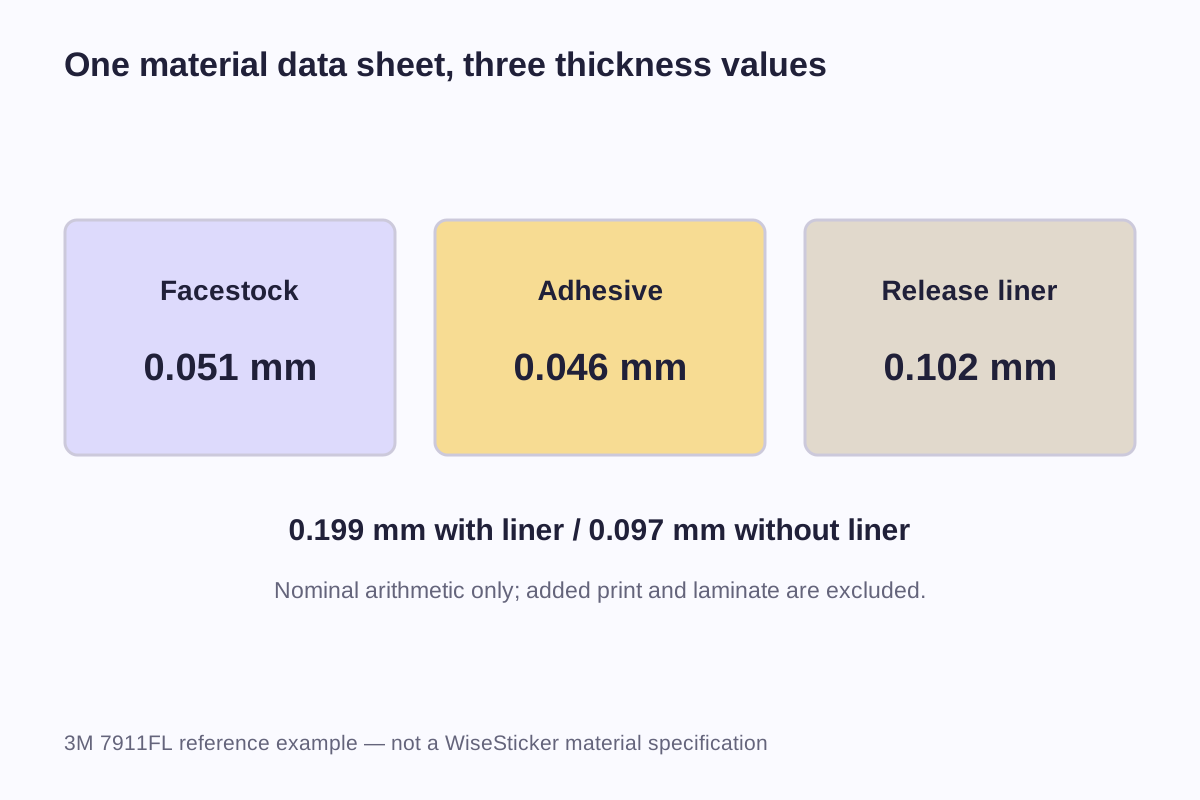
The 3M 7911FL technical datasheet lists these typical thicknesses. The manufacturer identifies its data as representative, not specification limits.
| Listed component | Typical thickness |
|---|---|
| Polyester face | 0.051 mm |
| Adhesive | 0.046 mm |
| Polyester liner | 0.102 mm |
Adding those stated values gives 0.199 mm with the liner. Removing the liner from that arithmetic leaves 0.097 mm for face plus adhesive. Neither sum includes ink or a laminate added later.
These calculations use 3M's listed values. They do not describe WiseSticker stock or imply that we use this material. The rounded typical figures help explain the layers, but a finished sticker's thickness tolerance still needs its own specification.
Why gsm does not give one thickness
Grams per square meter, or gsm, describes mass per area. Thickness describes distance between surfaces. Two papers with the same grammage can have different thicknesses because their structure and density differ.
For a 100 × 100 mm piece, the area is 0.01 square meter. A face paper rated at 100 gsm would therefore have a calculated mass of 1 gram over that area, before counting other layers. That calculation still says nothing definite about its thickness.
Use a stated caliper or thickness measurement when thickness matters. Do not convert a paper's gsm directly into microns without the additional material information needed for that conversion.
Match the material to the way the label will be used
A gift box, a chilled bottle and an equipment panel put labels through different conditions. The following three examples show which details matter for each job before you compare material grades or approve a sample.
Dry indoor packaging
A label on a cardboard gift box may primarily need a suitable print appearance, readable text and adhesion to the box's actual finish. A coated box and an uncoated one should not be treated as identical surfaces.
Applying the printed sample to the box lets you compare the design, surface feel, label edge and any handling marks together. If customers will write on the label, try the intended pen on that printed finish as well; a blank piece of paper may behave differently.
A bottle that develops condensation
Water reaches more than the face of the label. The printed image, any surface finish and the adhesive edge all need consideration, as does whether the bottle is dry or damp when labeled.
The material request should describe the bottle, application conditions and later exposure. The waterproof versus water-resistant guide explains how to record these conditions and observe different kinds of failure. A film name or glossy surface cannot replace that assessment.
Equipment identification
A label on equipment may need to remain readable after handling, exposure to a named cleaner or use at a specified temperature. A general request for an industrial material leaves those conditions undefined.
The outer surface, printed information and expected handling should guide the material choice. Test data is most helpful when it names the same adhesive, cleaner and surface as the proposed job. Otherwise, it may describe conditions the equipment label will never encounter or omit ones it will.
Compare quotations on the same basis
For a fair price comparison, each quotation needs the face stock, adhesive, printing, finish, cut dimensions and supply format. A price that includes lamination covers an additional layer and process. Comparing it with an unlaminated option without accounting for that difference can give a misleading impression of cost.
For custom stickers and labels, the design and intended use can be discussed before every material choice is fixed. An artwork reference, photograph of the receiving surface, approximate dimensions and quantity give the discussion a concrete starting point.
Keep the selected sample's identification with the order details. A replacement from another batch or supplier may look the same while using a different grade or adhesive. Where performance is documented, those material details help establish whether the existing data still applies.
Frequently asked questions
Vinyl commonly means PVC film in sticker and graphics catalogs, but the specific product description should establish the composition. Treat the names as potentially overlapping, rather than assuming they describe competing materials. Grade, adhesive and finishing still distinguish individual products within that category.
PET describes the face film. Whether the finished label tolerates water also depends on the ink, surface finish, adhesive, item being labeled and type of water contact. The data and sample results need to cover that combination, rather than a different PET label used under other conditions.
Only if the measurement says it does. A datasheet may list the face, adhesive and liner separately, while a quotation may use a combined figure. Ask which layers are counted. The release liner is removed during application, so it does not contribute to the sticker's thickness on the item.
Matte and gloss describe appearance, not an abrasion rating. Scratch behavior depends on the particular surface layer and how it is contacted. Compare relevant test information or samples under the expected handling conditions rather than choosing solely from the finish name.
No. Extra thickness may come from the liner or a decorative layer, and neither automatically improves adhesion or resistance to the expected exposure. Select the construction for the surface, print and use conditions; use thickness where the physical profile matters, such as a recess or a tightly fitting package.
Related guides
- Waterproof vs Water-Resistant Stickers: What to Look For
- Clear vs White Stickers: How Backgrounds and White Ink Change the Design
- Epoxy and Domed Stickers: Resin, Thickness and Shape
Tell us what the sticker will touch, how the item will be used and the appearance you want. Include the artwork, dimensions and quantity so we can discuss suitable material and print options.
Discuss Sticker Materials